
The book
For when you've read the books, and the pattern is still there.
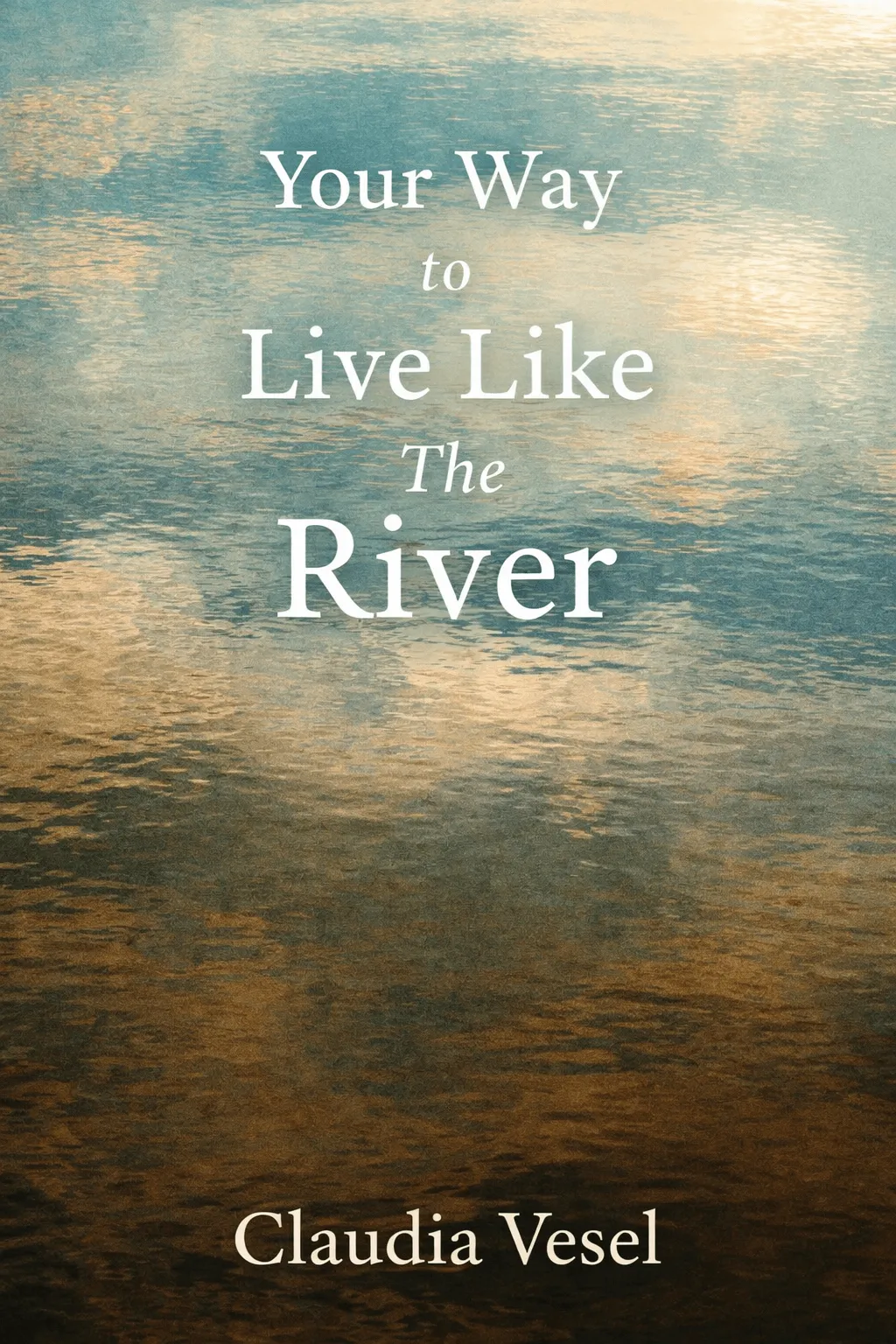
Your Way to Live Like the River by Claudia Vesel. A deliberate transformation process in five stages, written from the inside of the feminine path home.
If your abilities were shaped by survival, mapping them more precisely doesn't free you. It optimizes the cage.
The only honest promise: even reading it will shift your perception.
You've read the books.
You know your story, you've named the patterns, maybe you've done the therapy. And something still runs underneath.
Your Way to Live Like the River doesn't map what the wound built. It goes underneath it. Across six territories of your life — body, relationships, work, money, space, your days — down to the one belief running all of them. Through the armor, the lineage, the guilt and the shame that were never yours to carry. Then back up: to a calling shaped by what you grew through, and to what was available all along — loving yourself.
No wishful thinking, no manifesting tricks. Questions, exercises and rituals that work from the cause, not the effect. Written for the feminine path home, and for anyone who walks it.
Every pattern was once the best available answer.
It protected you, kept you safe, gave you a place when you had no other. That's why it doesn't leave when you understand it.
They are all programs that are still running because no one has told them the danger has passed.
This book doesn't fight your patterns. It acknowledges what each one was protecting, and only then lets it go.
Why understanding isn't enough.
There are two kinds of change. The first is cognitive: you recognize a pattern, decide to act differently, and repeat it until it holds. The second happens in one moment, when something connects deeper than understanding. From that moment, you cannot unsee it.
The book starts there, with how emotional memory actually works, and why some of what you've tried didn't work.
The wound and the gift are the same thing, seen from different points in time.
A page from the book
Was it ever enough?
Stage I · I See My Money and My Success
What happened when you showed what you'd done? When you brought home a drawing, a report card, an achievement. When you wanted to be recognized for something you'd created or accomplished.
Were you appreciated? Then you learned that what you do has value. You have confidence in what you produce.
Were you ignored, overlooked? Then you learned that you're invisible and your effort goes unnoticed. Why even try.
Were you corrected? Then you learned that nothing is good enough. And you still correct everything ten times before showing it to anyone.
Read the full pageShow less
Were you mocked? Then you learned to make yourself small. Not to risk the embarrassment of being seen trying.
Were you compared? Then you learned that your worth is relative. Always measured against someone else.
Were you overpraised? Everything was brilliant, regardless of quality. Then you learned not to trust any praise — because you can't tell what's real from what's performance.
Was it ever enough? You got a high grade, but it had to be higher. You succeeded, but it could have been better. You got a 9 and were asked, “Why not a 10?” That's when you learned that the finish line doesn't exist. And you keep running. Now you accumulate credentials, certifications, diplomas — not out of curiosity, but out of a need to prove yourself. Two jobs, three jobs. Not for the money — to feel like you're enough. But you never get there — because the problem was never your competence. It was that someone didn't say “enough” in time.
Inside
Five stages, and where to begin.
- Before You Start
- How this actually works, and where to begin.
- I. What Your Life Is Telling You Right Now
- An honest inventory of six territories, down to the one root belief.
- II. Deeper Healing
- The body as teacher, the independence trap, the lineage, and the release of blame, guilt and shame.
- III. Reclaiming Your Purpose
- Your strengths, your design, your calling, and a real first step.
- IV. Embodiment and Becoming
- Closing old commitments, meeting resistance, building the roles you need.
- V. Feeling Complete. Living Like the River
- What was available all along.
There's no deadline. Start where your life is burning. Stop when it's too heavy. The material will wait.
Who it's for
For the woman who has done the work and is still here. Who was told she's so strong, and is exhausted underneath. Who can give everything and receive nothing without guilt.
The feminine path back … was never written, but it is lived. This is an attempt to write it from the inside.
What it draws on
The tools come from solution-focused work, shadow work, systemic approaches, ancestral integration and embodiment. The principles come from Kabbalah, A Course in Miracles and Taoism.
Read them as engineering, not religious commandments.
First page, last page
Nothing in this book will give you something you don't have. The resources to see yourself clearly, to heal what needs healing, to recognize your purpose — they are already in you. They always were. What this process does is remove what's covering them.
Your task is not to seek for love, but merely to seek and find all the barriers within yourself that you have built against it.
Access the Book
English edition: ebook · print · audiobook (ElevenReader). Romanian edition: ebook · print coming soon.
The book continues
Most books end on the last page. This one has a companion. Claudie works from this method, in your language, and holds the thread with you.
English Edition — Digital & Print
Audiobook — English
Romanian Edition — Ediția în Română
This book is a space for exploration, healing and personal growth: a complement, not a replacement for professional care.
Meet Claudia
I love people. Not individually in the sense of needing to know everyone's story — but collectively. I love humanity. I see the beauty in our struggle, the courage in our survival, and the potential in our transformation.
Human mind lover, by design.
I know when something fails, fixing the symptom will bring a different version of the same failure. You find the root cause and you change the system.
This book is the map I wish I'd had. This platform is the guide I wish I'd had.
Read my storyShow less
The last two decades of my life were shared between business strategy, the systems that make aviation work and exploring humanity as a passionate reader and learner. They all share the same laws.
I know when something fails, fixing the symptom will bring a different version of the same failure. You find the root cause and you change the system. And you don't remove a safety system until you understand what it was protecting against and have a better one ready to replace it.
A sound business strategy is one that builds a system around people's needs and not around business metrics. Where the ability to read a system accurately — not as you wish it were, not as it presents itself, but as it actually functions — makes the difference between strategy and fantasy.
All ancient wisdom was pointing to the same laws — in a different language. Kabbalah, Taoism, A Course in Miracles, the great contemplative traditions — they were mapping the same territory that systems thinking and trauma science are mapping now. The language changed. The laws didn't.
The sequence you will find in the book — acknowledge, thank, forgive, release, build — is the accident investigation protocol applied to the human psyche. What happened. Why it happened. What it was protecting. What needs to change. What gets built instead. The process is a strategic approach of meeting your needs and building around them.
I've explored human nature through psychology, spirituality, systems thinking, and embodiment — formally trained in some, self-taught in others, genuinely curious about all of it. Not to collect credentials, but because I wanted to understand how life actually works. I tested all of them on myself first. I kept what worked, noticed when it stopped working, and learned when each one opens something and when it closes it. What I found is that healing isn't linear, purpose isn't a destination, and wholeness doesn't mean "fixed." Transformation is possible — not through perfection, but through openness, practice, and the willingness to keep showing up.
I grew up needing to truly see myself — not as a reflection of someone else's story, not measured against anyone or my accomplishments, just me. So I built what I needed — and made it available to everyone who has ever felt that same absence. This book is the map I wish I'd had. This platform is the guide I wish I'd had. And now is not my story — it's a framework for yours.
Questions about the book
Why do I keep repeating the same patterns?
Patterns repeat because the survival system that created them hasn't been acknowledged. This book maps three layers — childhood, ancestral, and collective — and works through each one to release the pattern at its root.
How do I break free from family patterns?
Family patterns travel through generations as inherited beliefs and protective behaviors. The book's five-stage process identifies what was inherited, acknowledges what it protected, and releases it — forward and backward through the lineage.
How do I find my life purpose?
Purpose isn't invented — it's recognized. The book uses a Kabbalistic soul pattern assessment to reveal your innate gifts, your natural channel of expression, and who you're here to serve. The wound and the gift are the same thing seen from different ends of the journey.
Is this book therapy or self-help?
Neither. It's a working system — five stages of practical transformation that go deeper than traditional self-help and move faster than therapy. It trusts your intelligence, names its sources, and acknowledges its limits.
Who is Claudia Vesel?
Claudia Vesel is the author of Your Way to Live Like the River and founder of Live Like the River. Her background spans over two decades at the intersection of aviation safety systems, business strategy, and human psychology. The Five Stages of Return framework grew from this convergence — the same systems thinking applied to safety-critical environments applied to the architecture of a human life.
What is the feminine wound?
The feminine wound is the inherited pattern of smallness — the promise made before there were words for it: to stay small, to never ask, to earn a place, to keep the peace. It travels through lineages as protective armor that outlives the conditions that required it. The book maps its origins, its expression across six life territories, and the path of return through self-forgiveness, reclaimed dignity, and the release of shame that was never yours.

A river doesn't reach the sea by forcing its way. It moves, finds the path the landscape already offers, goes around what it cannot move through, holds everything that has flowed through it without being defined by any of it.